Get Your Font Census Today!
Font Reality Check:
What to Do Now to Reduce Licensing Risk
Over the past year, printing organizations across commercial print, labels, packaging, direct mail, publishing, and in-plant operations have been confronting a new and uncomfortable reality: font licensing is no longer a background issue. It has become a material business risk.
Industry associations are hearing the same questions repeatedly from members: Why are we suddenly getting font audit notices? Why are licenses we’ve had for years being challenged? What responsibility do printers actually have for fonts used in production? How do we protect ourselves without disrupting customers or workflows?
Let’s clarify what has changed, what has not, and, most importantly, what responsible printers should be doing now.
What Has Changed: Fonts Are Being Actively Enforced
Many printers are discovering that fonts they have used for years, sometimes decades, are now the subject of license enforcement, renegotiation, or audit activity. In most cases, this is not because you suddenly did something wrong. It is because ownership and licensing structures have changed.
Over the past two decades, a large number of historic type foundries were acquired and consolidated. As a result, fonts that once came from many independent sources are now controlled by a much smaller number of rights holders. Legacy licenses, bundled software fonts, and informal internal practices are being reinterpreted under modern enterprise licensing models.
What Has Not Changed: Printers Still Have Obligations
Printers remain responsible for how fonts are available and accessed within their own environments. Fonts stored on servers, installed on workstations, embedded in workflows, or redistributed internally all represent potential licensing exposure—regardless of where the fonts originated.
Professional font assessments repeatedly show the same pattern: font sprawl. A typical print operation may believe it has 40,000–60,000 fonts, but a full census often reveals more than 100,000 font files, most of which are duplicates, near-duplicates, or legacy versions.
Without understanding which fonts are actually in use, which can be removed, and which can be replaced, simply paying a licensing invoice often locks in long-term cost without reducing risk.
The Responsible Path Forward: Font Mitigation
Responsible font mitigation is not about eliminating fonts or disrupting customers. It is about reducing risk while maintaining production stability through census, deduplication, canonicalization, substitution, and governance.
The best defense is proactive assessment and sharing best practices for mitigation and governance.
Fonts are licensed tools, not incidental assets. If you take control now by understanding their environments and governing fonts responsibly, you will be better positioned than those who wait for enforcement notices.
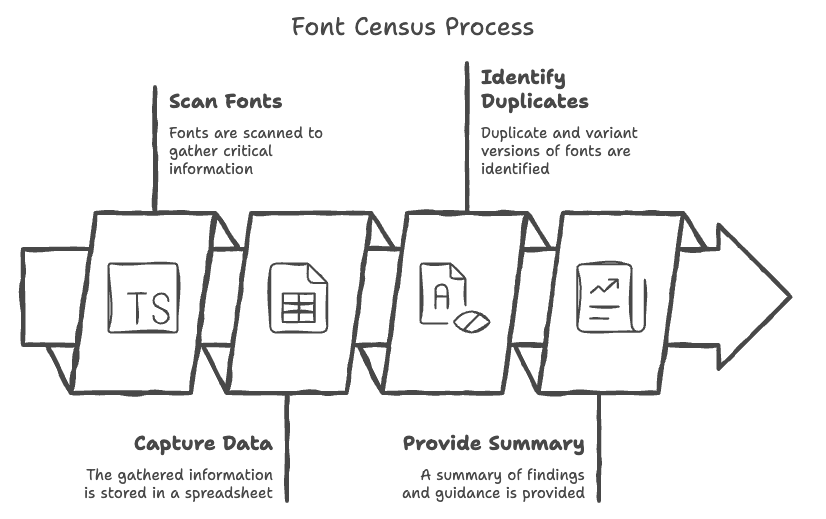
What happens during a Font Census?
- Fonts are scanned to discover critical information for the font type, maker, licensing, and other technical data.
- The output is captured in a spreadsheet for easy review and comparison.
- Duplicate and variant versions of fonts are identified.
- An summary of findings is provided along with guidance on font hygiene and remediation to consolidate and manage font assets.
FAQ
Frequently Asked Questions
Who needs a Font Census?
The Font Census is designed for printing companies, print service providers, and agencies that must license and manage fonts.
Why is a Font Census important?
Font management, including policies for licesning, use, and storage, have always been important for anyone in design, graphics arts, and printing industries. Now it is even more important as some font foundries are actively monitoring licensing and usage with surprising increases in licensing costs.
What happens during the Font Census?
All of your fonts are analyzed using a utility application to find the locations and metadata of fonts in your environment. The information is catalogued in a spreadsheet for easy review. A report of the findings along with a plan to mitigate duplicate fonts and improve licensing costs is created and shared.
How long does the Font Census take?
From start to finish the Font Census usually takes 2-4 weeks. Much of that time is coordinating the statement of work and logictics details with your team.
Who is behind the Font Census?
The program is orchestrated by Pat McGrew, a consultant and analyst in the graphic arts industry with decades of experience.